Showing posts with label nutritional labels. Show all posts

Friday, December 7, 2012

A-Z of Good Health

Everyone knows their ABCs but what about your ABCs to good health?


With an increasing number of products at the supermarket labelled with nutritional benefits such as "fortified with Vitamin D", "iodised" and "added potassium" it is time to decipher the actual benefits of such nutrients and reveal the natural sources in which they can be found.

VITAMINS

Vitamins are separated into 2 categories: water-soluble and fat-soluble.

Water-soluble vitamins (B complex & C) are transported around the body by fluids such as blood, and need to be consumed on a daily basis as they are not stored in the body.

To ensure you are obtaining enough of these vitamins in your diet, follow these guidelines:
  • 4 serves of wholegrain cereals (a serve is equivalent to a cup of breakfast cereal or a cup of cooked rice)
  • 3 serves of low fat dairy foods (a serve is equivalent to a 250ml cup of milk or a 200g tub of yoghurt)
  • 1 serve of lean protein foods (a serve is equivalent to one small chop or two small eggs)
  • 2 serves of fruit (a serve is equivalent to a medium apple or 2 small kiwi fruit)
  • 5 serves of vegetables (a serve is equivalent to a cup of salad or ½ cup of cooked vegetables)
Fat-soluble vitamins (A, D, E & K) on the other hand are dissolved in fat before being transported around the body by the bloodstream. This means that they can be stored in the body until they get used, so as long as you consume enough of them, you don’t have to consume them every day.


MINERALS

Minerals are essential nutrients your body needs to function well. We need minerals to undertake functions such as building strong bones and teeth, turning the food that we eat into energy and making hormones. There are many other minerals that we need in tiny amounts, yet can’t live without which are called ‘trace elements’. Consuming a nutrient-dense diet will ensure you meet your requirements of trace minerals as well!


So now that you know your ABC, it's time to be as healthy as can be!

JW


References
  • https://www.morethanmedication.com.au/Eat-well/Know-your-ABC-to-good-health/

Wednesday, November 16, 2011

Trick or Treat

Halloween may have come and gone this year but there is still plenty of trick or treating going on - in the supermarket, that is.


Food is marketed in a way which makes it appear healthy and nutritious when in fact it is quite the opposite.

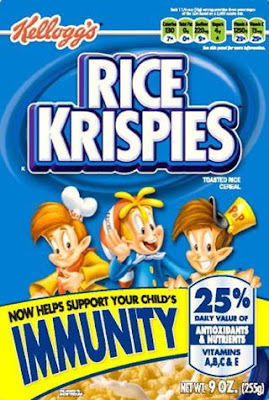
Take this product for example:

This is a box of Kellogg's Rice Krispies (known as Rice Bubbles in Australia and NZ). What information do you think they are trying to get across? The main messages on this box are:
  • helps support your child's immunity
  • 25% daily value of antioxidants & nutrients (Vitamins A, B, C & E)
  • made from rice

Now let's dig deeper and see what they are NOT trying to get across:
  • the actual rice crisps are made of rice and a sugar paste
  • no scientific evidence of actually supporting children's immunity
  • first 4 ingredients are: rice (white rice, a high GI product), sugar, salt, malt flavouring
  • simple carbohydrates which do not provide sustainable energy
  • highly processed
Rice Krispies are just one example of misleading advertising particularly targeted at children and mothers.

Tricks NOT Treats

There are plenty of products on the supermarket shelves labelled as 99% fat free. This is great news for those who are looking to lose a few pounds - but is it really? Yes it may be 99% fat free but how about sugar content, salt and preservatives? Usually a product's nutritional claim to fame is also a cover for something else. So beware!


If that wasn't confusing enough, basic ingredients such as fats, sugar and sodium have multiple names. I guess criminals are not the only ones who go by aliases.

Aliases of fat: Saturated – beef fat, butter fat, shortening, coconut, coconut oil, copha, cream, dripping, lard, sour cream, palm oil; Monounsaturated – canola, olive oils, margarines, peanut oil, avocado, nuts; Polyunsaturated – seeds, sesame, sunflower, safflower, corn, soya bean, grape seed oils, mayonnaise, margarines, fish oils


Aliases of sugar: honey, sucrose, maltose, lactose, fructose, dextrose, glucose, malt, glucose syrup, corn syrup, monosaccharides, xylitol, polysaccarides, manitol, sorbitol, ‘carbohydrates modified’, molasses, disaccharides


Aliases of sodium: salt, monosodium glutamate, meat extract, yeast extract, hydrolysed vegetable protein, meat protein, stock, vegetable salt, baking soda, baking powder


The most nutritious foods are the ones that do not come with a label - these are foods that come straight from the ground or have a mother. They do not need fancy labelling or a catchy slogan, they speak for themselves. But in this day and age convenience seems to take priority.

So try and spend a little extra time at the supermarket and make sure you know what you are ACTUALLY buying and not what the manufacturers want you to think you are buying!

JW

Tuesday, September 13, 2011

Nutrition 101 series: Understanding nutritional labels

Do you ever find yourself at the supermarket looking at two similar products wondering which one if better for you? You look at the nutritional panel on the back but don't quite understand what the numbers mean. Well you're not alone.


Is a product healthier just because it is 99% fat free or is low sugar better? Well let's break it down to basics. Nutritional panels are not all the same but generally they should have the basic info on total energy, fat, carbohydrates and sodium. The numbers will either represent the amount of calories or kilojoules, or be a percentage of the recommended daily intake.

Usually there are two columns on a panel - the first being the nutritional values of the serving size, and the second the nutritional value in 100g. Some foods might have a percentage of the recommended daily intake instead. Serving sizes vary between products so it is hard to compare foods based on this. The nutritional value in 100g is the easiest way to compare different food items.

When you are looking at individual food items it is VITAL to look at both sets of numbers to make sure you are eating the right amount of calories. Let's use the following nutritional label as an example. This particularly label doesn't state the serving size but using some basic math it works out to be approximately 300grams.

KEY THINGS to look out for include:

1. TOTAL ENERGY (kcal or kJ)
The label above shows that there are 315 kcal or 1345 kJ in ONE serving size. An average adult has a recommended intake of 2000 calories or 8368 kilojoules per day. So this particular food provides 16% of the recommended daily energy amount.

2. PROTEIN (g)
There is 23.7g of protein in one serving which makes up 53% of the daily recommendation. This looks like a lot but remember that the serving size is 300g which is approximately a medium sized meal.

3. FAT (g)
The total amount of fat is 12.6g BUT 8.1g of that is saturated fat. In my previous article I explained the different types of fats. Saturated fats are the kind you want to avoid along with trans-fats. Even though the total fat percentage is only 18%, the portion of saturated fat contributes to 41% of the daily recommendation. So it is important to look at the different types of fats in your food.

4. SUGAR (g)
You might be wondering why I have skipped over carbohydrates but what you might not know is that sugar is a type of carbohydrate. Carbohydrates provide us with a large portion of the energy we need to function but try to avoid foods which have sugars making up a large proportion of the carbohydrates. Sugar is something our body wants but DOESN'T actually need!

5. SODIUM (mg)
Sodium is usually expressed in milligrams but in this particular case it is written in grams. There is 0.72g or 720mg of sodium in one serving which makes up 30% of the daily recommendation.

So the next time you go shopping, why not stop and check the nutrition label using your newly acquire skills!

JW