Showing posts with label posture. Show all posts

Thursday, January 5, 2012

Fitness Programs 101 series: Pilates

Pilates has slowly increased in popularity over the years and now is very much part of mainstream fitness. In the past it was considered more of an alternative form of exercise mainly used for rehabilitative purposes, but is now largely available at most gymnasiums worldwide.

SO...WHAT IS PILATES?
Pilates is a conditioning exercise designed to improve spinal posture; increase strength - particularly of the core, flexibility and muscular endurance; and develop long, lean muscles. It encourages awareness of one's body starting with breathing, which in turn helps your body function at its optimum level.


A BIT OF BACKGROUND
Joseph Humbertus Pilates was born in Germany in 1880 to a prize-winning gymnast father of Greek heritage and a naturopath mother.

As a child Joseph suffered from numerous illnesses including: asthma, rickets, rheumatic fever. And as a result began his interest in health by studying anatomy and reinforcing his learnings by observing animals in the woods - “Take a horse, if a man wants to race him, he keeps him in top form. He makes the horse move. Why not keep humans in top form too?"

Joseph Pilates preforming a single leg row on an early version of a pilates reformer bed

In 1912, Joseph moved to England. When World War I broke out, he was imprisoned due to his German citizenship, along with other German nationals. While in prison camp, Joseph observed animals stretching and incorporated this into the foundation of his matwork. He taught his fellow prisoners exercises using reassembled camp beds, with the springs acting as a form of resistance.

The effectiveness of his methods were proven following the influenza outbreak in 1918. The pandemic killed somewhere between 50-100 million people worldwide with those in close cohabitation were hit the hardest. Unbelievably, those who followed Joseph Pilates' exercise routines all survived the outbreak.

Joseph originally named his exercise method "Contrology". It was his belief the mind controlled all muscular movements through centred concentration - "The Pilates Method teaches you to be in control of your body and not at its mercy."

TYPES OF PILATES
1. Matwork
The traditional method of pilates, performed on mats. Exercises are performed on your back, side or front. Sometimes equipment (eg. weights, resistance bands, rollers, exercise balls) is used.
Examples of mat exercises: pelvic curl, the hundred, bridge, rocker


2. Reformer beds
A spring-loaded machine with a moving carriage. The springs act as resistance - the more springs, the higher the resistance.


3. Pilates Cadillac
A large piece of equipment featuring leg springs, arm springs, hanging loops, a push-through bar and a trapeze. Over 80 exercises can be performed from gentle spring-assisted sit ups to advanced acrobatic movements.


4. Winsor Pilates
This method of Pilates was developed by Mari Winsor, a dancer and teacher from Hollywood, California. Combining matwork and cardiovascular movements, Winsor Pilates provides a low-intensity body sculpting workout which burns calories for weight loss.


5. Stott Pilates
A contemporary approach to traditional Pilates. Joseph Pilates initially developed machines that users had to adapt to. With Stott Pilates, the machines adapt to you.


For me personally, Pilates holds a very special place in my heart. Pilates was my long awaited solution to years of excruciating back pain. I had tried everything on the market - physios, chiros, GPs, medications, rest; but none provided me with permanent relief.

Pilates made me understand the cause of my pain and how I could rectify the situation to prevent it from happening in the future. And I am very happy to say it worked!

So do something good for your body and try Pilates today!

JW


References
  • www.josephpilates.com
  • www.livestrong.com

Monday, October 24, 2011

Analyse This

If Dr Ben Sobel (Billy Crystal) was able to analyse mob boss Paul Vitti (Robert De Niro) not once but twice on the big screen, how hard could analysing your posture be? If you have no idea who I was talking about, you'd better go to your nearest video store and rent 'Analyze This' and 'Analyze That'.


The next time you're standing in front of the mirror, take some time to check out your posture. It only takes a couple of minutes but it could save you a whole lot of money and pain further down the track.

Good posture is like a well tuned car - it allows your body to function to its full potential. The more you look after it now the less you have to get it checked and fixed later.

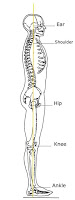
Here's a little activity for you to do - check the state of your posture by standing side on in front of a mirror and look for the following:
  • a slight forward curve in the neck (cervical vertebrae)
  • a slight backward curve in the upper back (thoracic vertebrae)
  • a slight forward curve in the lower back (lumbar vertebrae)
  • the ears, shoulders, hips, knees and ankles should all be in alignment as if a plumb line were drawn from the top of the head to the feet

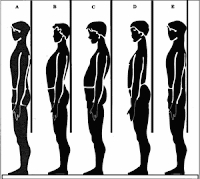
If you have all of the above then congratulations - you are one are the lucky few who has perfect posture. Here's another activity to try: stand against a wall in your natural position and get a friend or a family member to see which of the following best represents your posture:

Posture A: perfect posture
Posture B: hyperlordotic curve - excessive curvature in the lower back region (lordosis)
Posture C: hyperkorphodic curve - excessive curvature of the upper spine, forward tilting of the neck (kyphosis)
Posture D: flat upper back & hyperlordotic curve
Posture E: flat back - lack of curvature in the cervical, thoracic and lumbar spines

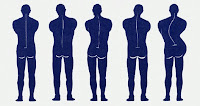
Starting from left to right:
1. Perfect posture
2. Uneven shoulders - one shoulder is higher than the other
3. Uneven hips - one hip is higher than the other
4. Tilted head - the head is tilted to one side
5. Severe scoliosis - spine is abnormally curved

Signs and symptoms of poor posture:
  • back pain
  • neck pain
  • constant headaches
  • prone to injuries
  • rounded shoulders
  • hunched back
  • problems sleeping
Developing good posture takes time and commitment before it becomes a natural habit. Every time you sit, stand or lie down make a concerted effort to adjust your posture into the best possible position. Here are some simple tips to get you started:

Sitting
  • sit up tall and keep your shoulders back and down
  • head should be looking straight ahead - not tilted up or down
  • adjust chair height so that your knees are at a 90° angle with feet flat on the floor
  • keep weight evenly distributed on both hips
  • substitute your chair for a fitball

Standing
  • stand with your feet shoulder width apart with weight evenly distributed
  • stand up tall and keep your shoulders back and down
Lying down
  • ensure you are sleeping on a firm mattress otherwise you are asking for poor posture
  • if you sleep on your back - place a pillow under your knees or a towel under your lower back
  • if you sleep on your side - keep knees slightly bent, a pillow between your knees can help

If you have poor sitting, standing or lying posture, imagine how this affects you when you exercise. Exercise puts a lots of pressure on your joints and muscles - if your body is not aligned in the best possible way, exercise can exacerbate your poor posture. Like any problem that starts off small but is left unattended, things can get a lot worse very quickly.

You may notice that a lot of elderly people have hunched backs. This is the result of poor posture not being addressed early in life. Our grandparents did not have the luxury or the knowledge we have today in improving our postures.


So take a little time to check your posture because this is one thing you cannot take for granted!

JW